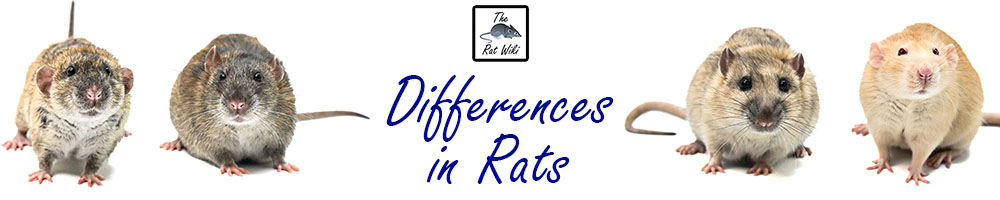
Here we will be taking a look at some of visual differences in rats for those new owners or people thinking of getting some rats who want to learn a little bit more about the basics.
Although there is no differences between the different varieties of fancy rats we keep (as in the general layout of the rats overall) there is quite a lot of small factors both visually and physically that can make them differ from others.
From ear placement to eye colour and to coat types and colours. Here I will go a little more in depth for people so they can hopefully learn something new and finally understand what someone is saying when they say something like “I’ve got a Pink eyed Siamese Dumbo Rex Buck” and you’re not quite sure what language they are talking in.
So here we have the basics of differences in rats for beginners:
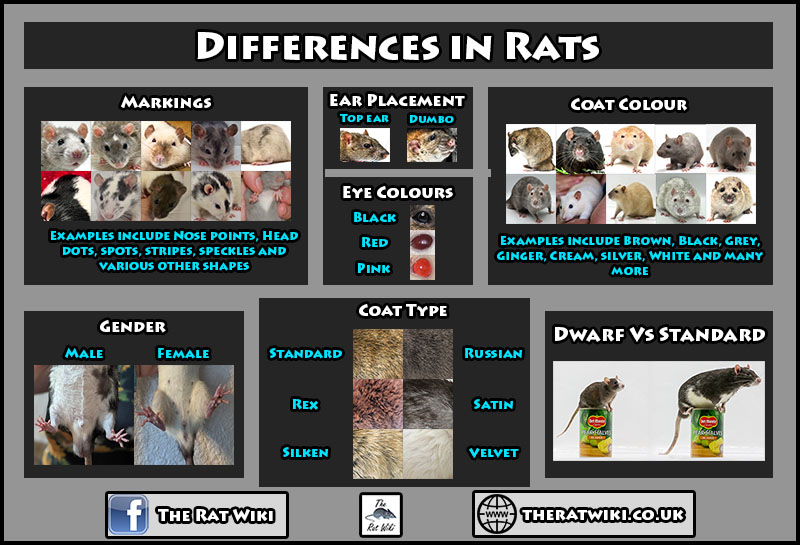
Ear Placements
 Standard Ear
Dumbo
Very easy here you have 2 types. Standard ear (or top eared rats as they are often called) have ears that are on the top of the head pointing upwards and Dumbo rats are more to the side of then head and much rounder. Despite rumours passed around on the internet there is no difference in temperament or behaviour between any of these. The only differences here are purely just positioning of the ears.
Eye Colour
Black Eye
Red eye (aka ruby)
Pink eye
No difference in any eye colour with temperament. Pink eyed rats usually have poorer vision than others and can spook a little easier if you don’t let them know you are near. They tend to “Sway” more than other rats although any rat with any eye colour can do this too. Swaying is when they move their heads in a side to side motion which helps with their vision to focus on things better.
Coat Type
Standard Coat
Rex – Shorter hair than normal and Curly. Waving fur is present especially in younger rats so can look woolly. Curls will clump together a lot exposing bits of skin underneath. Curly Whiskers too.
Russian – Coats are thick and denser than other rats which can feel softer and silkier to touch.
Silken – Previously known as Silvermane. The Silken coat is long, fine and silky feeling and slightly translucent.
Satin -The Satin coat is semi-long, glossy and has a shine to it. The shine is due to the tips of the hair shafts being hollow which reflects light.
Velvet – Velvet coat is dense and plush and can be stroked in any direction without resistance. Whiskers usually slightly curved but not as much as a rex
Coat Types To Avoid
**Please note no ethical and reputable breeder will actively breed or home out the following types to people so see this as a red flag if you come across them**
Harley – Harley fur is long and wispy. Can look greasy or wet. The Harley gene is thought to have difficulties processing protein which causes significant skin issues. This can be managed with a low protein diet but taking away the protein cause other health issues and it makes it not a balanced and nutritious diet. Top ethical breeders in the UK have worked to try and remove or reduce this but this hasn’t been successful and is now thought of as an unethical coat type to breed.
Hairless – Hairless rats have no fur and even if they grow a small amount of fuzz it usually will fall out. Health issues include bad skin issues, high rates of kidney failure and shorter life spans. They are more prone to getting more severe cysts and have lactation problems meaning when being bred most babies likely to starve if no intervention happens. Whiskers are either non existent or not very well formed which is a huge deal to a rat. This is essentially taking away an important sense on a rat. Hairless are a banned NFRS variety.
Coat Colours
There are a huge amount of different coloured varieties of rats. These colours are all affected by different genes during the breeding process. It’s pretty complicated and breeders and variety judges will study and learn all the different ones to know what comes out from what rats are paired up together.
But the basics of this are that all rats are either agouti based (These are the Brown coloured rats we see in the wild in the UK) or self based (Black). All Other colours we see are just one of these with additional genes that change the expression of the colours that come out during the breeding process. But from this we see rats come out in all sorts of colours from Whites, Creams and Silvers to blacks, browns and oranges.
Different Markings
Again just like with coat colours the different markings are all affected by different genes during the breeding process. Breeders will study and learn all the different ones to know what comes out from what rats are paired up together. All the different markings have official Variety Names and classes in Rat shows. For example Irish is a triangular shape on the underneath upper chest of a rat and this is classed as a “Marked Rat” However a siamese rat has shaded points on the nose and tail area of the fur and although this is a marking it’s classed as a “Shaded Rat” But to save over complicating this we will just call them markings for now. Other examples of markings you can see on rats are Head spots, triangle shapes on head, Stripe down back, speckled dots on top and on belly, a coloured hood and much more.
Gender
In general there are usually noticeable differences between the genders of the rats. This doesn’t mean all Boys or Girls are the same as we will say below but the general feeling in the rat community will agree with the following:
Male – Known as Bucks. Larger. Usually slower and lazier. More cuddly overall. Strong smell to them, musky or biscuity smell. Male parts are large and on display. Bucks tend to have slightly shorter lives than does.
Female– Known as Does. Smaller. Usually more active and faster. Would rather be off exploring than cuddling. Does tend to live longer than bucks.
Dwarf rats
Much smaller than standard sized rats due to having copies of the Dwarf Gene while being bred. While other dwarf types in animals can have health issues the Dwarf found in the fancy rat is actually quite healthy. It’s thought to be even more healthy than standard sized rats as it seems that the Dwarf gene can inhibit the growth of tumours for example. These health observations have not yet been fully scientifically proven yet but time will hopefully tell. They Cannot live with standard sized rats as they are much smaller. Fights would cause serious injuries and it’s not fair as the dwarf will likely get bullied a lot with bigger rats.
Anyway that wraps up some basic differences to get started on learning all the differences between the fancy rat. If you would like to see all the different varieties out their in the UK rat scene there is a full Picture Varieties section on The Rat Wiki Website which you can find HERE
 The Rat Wiki