
One thing I always seem to struggle with is finding a good guide on what wood is safe for rats. You often get a few suggestions from people and then there comes the sentence you don’t want to hear….“I think this one is safe.” Then you know you are probably back at the beginning in not knowing any better. ”I think” is something I really don’t want to risk with my rats and I’m sure there are plenty of people out there that feel the same. So I decided to do something about this and in my research early on I found a pretty good tip that most old school rat people seem to go by and that is “If it’s safe for rabbits then it’s safe for rats”
I’m more than happy to go by this rule too because owning both rabbits and rats I know all too well that rats digestive systems can handle pretty much anything whereas rabbits can be a lot more sensitive. The fact you have to be a lot more careful with rabbits can only be a good thing in making this guide for rats as there is better peace of mind. The fact is that a rat may be able to handle the wood a rabbit can’t and it be okay but why risk it? There are lots of safe woods out there to give more than enough options to a rat keeper so we will thank our bunny friends and make a much safer guide to ensure we keep out rats safe.
Make Wood From Outside Safe
Before we get into the list of safe and unsafe woods I just want to mention this guide was originally created to help people when buying toys/items for example in pet shops or garden centres etc as they are often made out of all sorts of different woods this would be a great place to check they are safe. However there also seems to be a lot of people who tend to wonder what woods can they bring into their rats cages from outside so I decided to expand my list to not only include common manufactured product woods but also woods that can be found in gardens, fields and forests.
With that in mind, before giving a safe listed wood to your rats you’ve found outside it’s heavily advised that you give treatment to the wood first. This is mainly to kill any parasites on the wood/leaves and also stop the spread of any bacteria and viruses. The best way to treat the wood is to put it in a large bowl and pour boiled hot kettle water over it. Then you can hang it up to dry out. You need to wait long enough for the sap in the branches to turn from green to brown. This can take anywhere usually from 2-6 months. Smaller branches and twigs can take a matter of days/weeks though.
Some people say to use bleach which isn’t advised in my opinion. Firstly It’s best to avoid bleach with rats completely really. You dont want them consuming anything that has been bleached and even if you rinse it well wood absorbs liquids so you won’t ever really get it all out. Plus rats have very sensitive respiratory systems so the smell of bleach can be quite unpleasent for them.
Putting it in the oven at a temperature of around 130C for about 45 minutes is an effective way of killing anything nasty in there. Dampening the wood first provides better results as moist heat kills more efficiently.However the downside to this are firstly your limited to small branches as nothing else will fit in normal sized ovens and also the dry heat will crack the wood on the outside which will just soak up any urine or faeces that comes near it. Freezing will likely not kill all parasites, bacteria bacteria or viruses. Most trees and parasites in the UK will have adapted well to the cold winter temperatures as part of their cycle so putting them in the freezer would not be effective. Avoid trees which are near heavily used roads due to pollution levels being higher or any that could potentially have been sprayed with chemicals.
Safe Wood For Rats
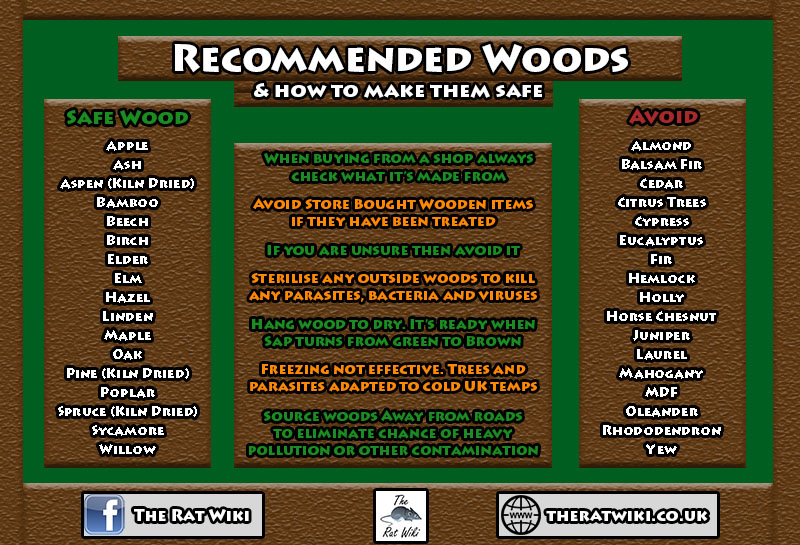
Alder
Apple
Arbutus
Ash
Aspen **
Bamboo
Beech
Birch
Borage
Blackberry/Raspberry Bush
Buddleia
Cottonwood
Elder
Elm
Hawthorn
Hazel
Linden
Maple
Mulberry
Oak
Pear
Pine **
Poplar
Rose Bush
Spruce **
Stone fruit Trees (Apricot, Cherry, Peach, Plum)
Sycamore
Willow
** (Must be kiln dried otherwise toxic)
Unsafe Wood For Rats
Almond
Balsam Fir
Box
Cedar
Citrus Trees (Lemon, Lime, Orange)
Cypress
Eucalyptus
Fir
Hemlock
Holly
Horse Chestnut
Juniper
Laburnum
Laurel
Mahogany
MDF
Oleander
Privet
Rhododendron
Yew
There are obviously lot’s more options out there for woods but I’ve aimed to cover the most listed and readily available as possible. Plus for the more unique and less common ones I honestly couldn’t tell you for sure if they or safe or not so I’m not listing them at all. Hope this guide helps.
 The Rat Wiki