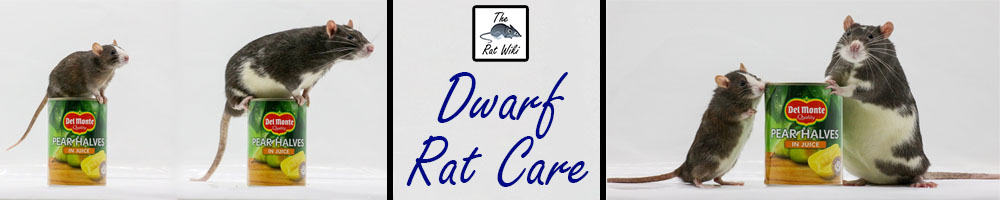
Dwarf rats have been a thing in the UK scene for nearly 10 years now but as it goes for pet homes in particular they are seemingly a relatively new thing. Over the last few years they have been increasingly seen more at rat shows especially after the NFRS granted them a class as a provisional standard meaning they can be entered as a in the variety sections of shows. However as for availability for homing they are still in short supply. This is mainly because there are a smaller amount of breeders of dwarves at the minute and they are either keeping a lot of them to improve their own lines or passing them onto other breeders to work with.
We seem to be getting to the stage now where more and more are going out to pet homes so with that in mind it seems like a good time to have a space on The Rat Wiki that covers specific information related to dwarves and also runs through a few differences of care needed compared to standard rats that you may know. Whether you are a dwarf keeper, possibly interested in keeping them and want to know more about them or just interested to learn in general this page is a great start.
Background
Dwarves were first brought over to the UK from the US in 2016, this was part of a large scale operation organised by Kaiju Stud. It was overall a large 2 wave import that saw 70+ rats come over and were then split between Kaiju Stud and Skatta Stud who shared in the cost of bringing them over. As well as actual dwarves there was also dwarf carried in the other lines of the varieties they brought over such as Marble and Silkens. Since then we have also seen a few more imports from Kaiju Stud from some European countries such as Germany and the Netherlands.
Unfortunately it was reported that there are some lines of dwarf rats which were imported in and then distributed into the back yard breeder circles. This makes it very important that you know the difference between a good dwarf rat breeder and one with questionable ethics and care so make sure you do good research on any you want to approach.
Check out the NFRS breeders list if you want to find some registered breeders of dwarf rats HERE
Showing and Standardising
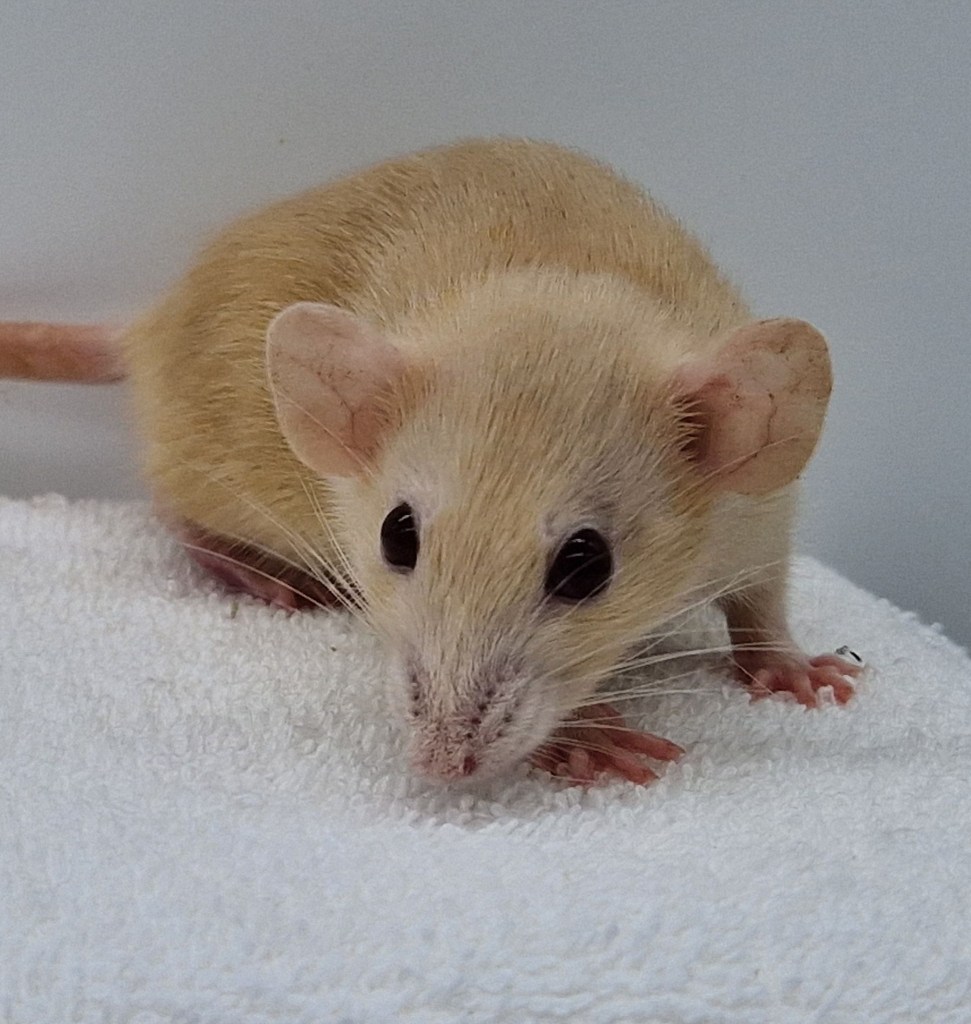
Since their import dwarves have been worked on by various different NFRS breeders and many still plan to continue, those that haven’t have passed them onto others to continue the development of the lines. They have been shown in the pets class enough at shows over the last few years to have been granted a “provisional standard” meaning they can compete in the varieties section. If shown enough they will move up to “guide standard” and eventually will have their own class at shows.
Here is the NFRS official standard on dwarf rats:
“To be less than half the size of a standard fancy rat but easily distinguished from a small example of same. All varieties recognised for other rats to be accepted.
Head to be shapely, similar to a standard rat but finer boned and pointed at the muzzle. Eyes big, round and bold with a good width between the ears. Ears to be large and well-shaped.
Body to show good length but slightly more rounded over the loin. This may give the appearance of a chopped rump but the bones of the pelvis should not be prominent to the touch.
The tail will not be as long or thick in comparison with a standard rat, but nor should it be square-shaped or excessively thin; the bones should not be visible. The tail will typically be held high during movement”
Health and Condition
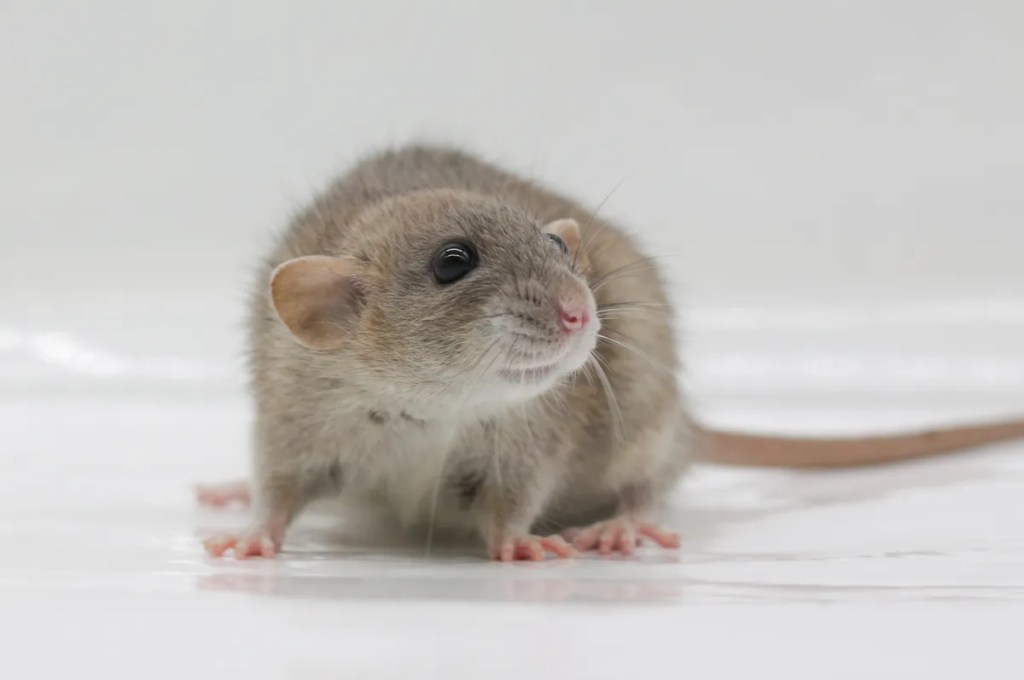
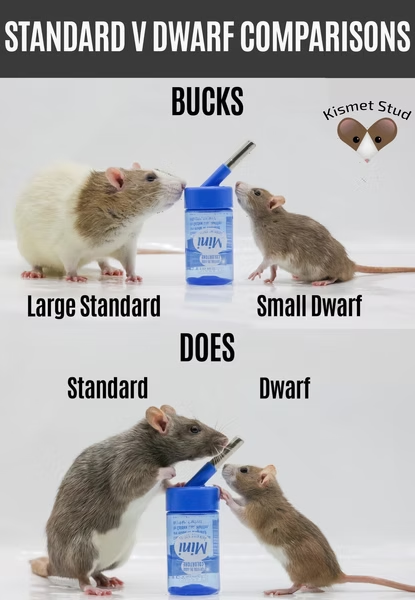
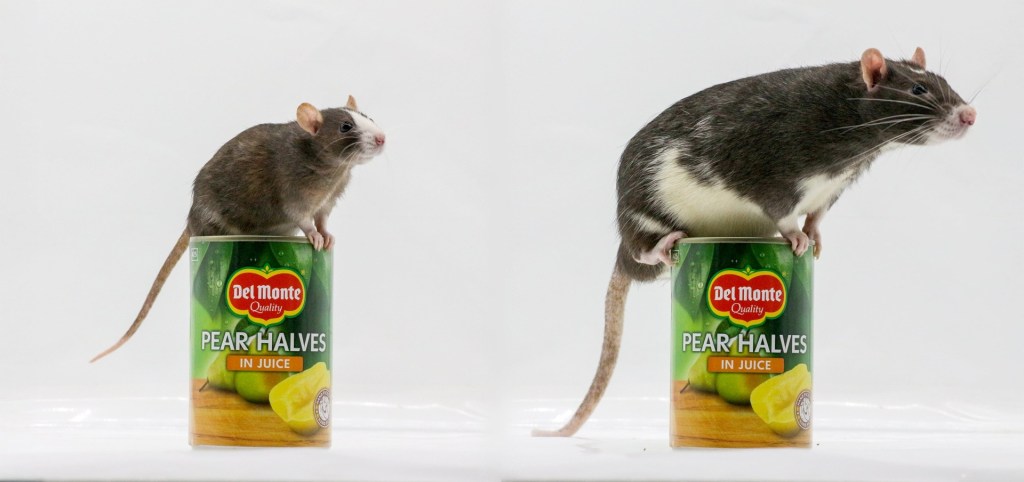
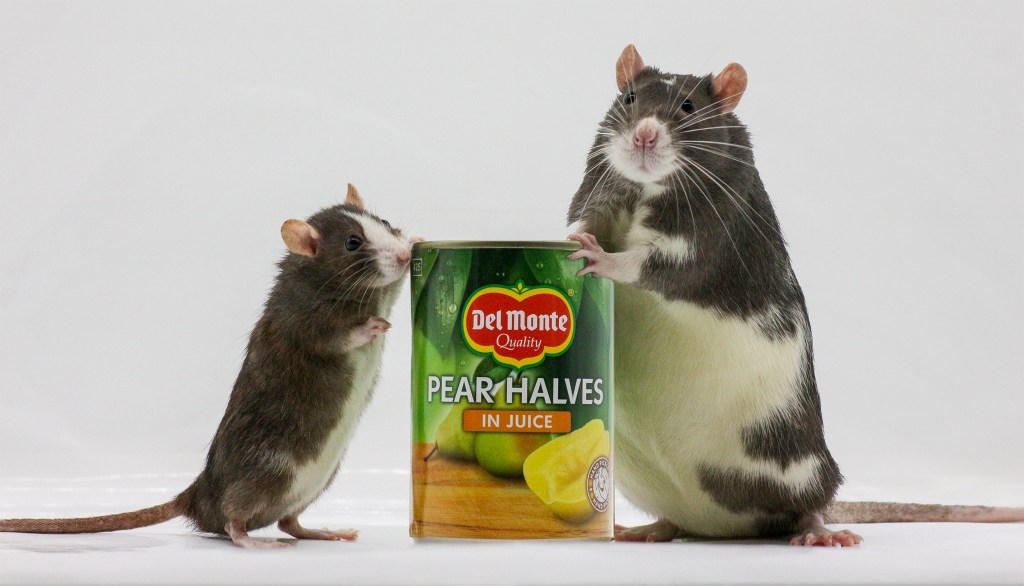
Size wise it’s better to look at a general size rather than rough weights. They should be roughly about 1/3 the size of a standard rat. Actual dwarves will be this small and should not be confused with “Carriers” which are offspring of Standard Doe to Dwarf buck pairings which can result in smaller generations of kittens when born. From what I’ve seen the 100g-120g is a good weight to expect for a dwarf doe and 130-150g mark is good for a Buck if “rough weights” were to be requested for a general idea. But like standard rats we shouldn’t rely on this as every rat is different and weight isn’t a factor compared to overall look and shape. The overall growth is thought to be much slower too so they will stay smaller for longer and compared to a standard rat won’t hit their peak size as quickly. This is the reason a lot of breeders will hold dwarf kittens a few weeks longer than the usual 8 week mark that standard rat breeders do. This is personal preference though from breeder to breeder for them just to give them a couple of extra weeks to grow and so the usual 8 week mark is still accepted for dwarf rats too. If you are looking to home dwarves it’s recommended to check with the breeder beforehand their timeframe on this to save confusion.
So as well as being about 1/3 the size of a standard rat they also look different in regards to type with the heads especially looking more like a hazel dormouse where they appear finer boned and more pointed towards the nose end. The eyes appear to be larger than average compared to standard rats and the ears differently proportioned. Also paw size seems smaller in relativity to the rest of their body.
It’s also been observed currently there seems to be 2 different types in regard to weight management needs. Some can be more on the lighter side with it being hard to keep weight on (especially in the winter) and others can put weight on very easily almost being beach ball looking plump so weight needs to be quite closely monitored with them. One major thing to be aware of is it has been reported that some undersized standard rats and young kittens have been passed off as dwarves by unregistered sources so it is very important to know what you’re looking for in size and shape when looking for dwarf kittens. It’s also a good example of a time where it’s very beneficial to do good solid research on ethical and knowledgeable breeders so you always make sure you can get your rats from good sources.
Now onto health issues (or seemingly much less instances of them) This is something I want to cover but want to make clear very early on that the following “claims” are early stage beliefs and are not long lived enough to take as fact just yet. Plus just because the following has been noted by certain dwarf breeders it doesn’t mean you will have the same if you decide to home dwarves. Take these claims as currently being interesting and hopeful patterns for the future.
It does “seem” that a lot of breeders have noticed that in general the overall quality of life seems to be better in dwarves than in standard rats. They seem to stay healthier for longer and with less health issues in total per rat. Certainly not in every case but patterns are being observed, as too is life expectancy which could be longer overall and certainly something if true to aim to breed towards. We could be a long way from that being confirmed and indeed true but exciting to follow nonetheless. I would still air on the side of caution and expect the standard 2-2.5 years we expect for life expectancy of a standard rat for now but if you get more from your dwarves then that’s a huge bonus.
Other health observations made from them are as follows:
- Reported to get less occurrences of tumours. This is believed to be linked to the lack of the growth hormone.
- Respiratory issues believed to be less frequent in dwarves
- Hind Leg Disorder seems to be less prevalent with very few issues being reported for them.
Hopefully these claims all turn out to be proven as it would mean better overall quality of life for longer but for now we have to be patient and wait and see.
Behaviour
Just like with standard rats you can expect the typical rat behaviours from dwarves. They are still full of personality, very curious and clever animals and make really good pets. Breeders have noticed a potential extra confidence with dwarves where they seem to settle into new environments better and appear more curious towards humans and relax quicker than their larger counterparts which, if true, is great news for new owners hoping to bond with them straight away.
Because of their smaller overall size they do have the capacity to be a lot more nimble and agile than standard rats . A lot have observed them to be much quicker getting from place to place especially with those moments with little bursts of energy which make them extra fast. People are often concerned that they are quite frail and delicate too, both with other rats and humans handling them in general. This isn’t the case though according to people who keep them. They are smaller overall that is fact but apparently can still rough and tumble with each other perfectly fine without any concern and holding them as you would any other rat is recommended. It’s all down to each individual rat and if they seem happy to be played with and handled in a more playful way or not.
One behaviour that seems to be very present in them which you might not see as a standard rat owner often is that they like to hang upside down from the bars at the top of the cage a lot. This is very easy to do for them because of their much lessened weight so cage setup should accommodate a bit more of a safer and softer environment at the top just to make sure if they fall they fall on something soft and don’t fall too far. The usual fall breakers, hammocks and nets technique should solve this nicely and help to prevent any injuries.
Bonding and homing
Some breeders will keep young dwarf kittens with standard kittens early on while they grow and also some have said they can be kept with “carriers” at young ages but when it comes to homing out to Pet homes it’s really recommended that they are only kept with other dwarves. Standard rats grow much quicker and will quickly have size, weight and ability advantages over dwarves. This can not only lead to risk or harm or injury due to standards being so much bigger than them but could also leave the dwarf rats subject to being bullied too. Some breeders will keep dwarves with their carrier relatives which are slightly smaller than standard rats due to them carrying the dwarf gene and have deemed this to be safe which is something to be open minded about. But with carriers being a rare asset for breeders nearly all of them will stay with them so for pet homes with Dwarf only rats keeping them only with other dwarves is much safer.
As for homing out ages there is a bit of a mix of opinion on this with neither being right or wrong. The general rule of the 8 week mark that we tend to see when homing standard rats is still to be the expected minimum but it seems that most breeders of dwarves feel more comfortable holding them back for a couple more weeks to give them a bit more time to grow and develop. This means expecting to wait till around the 10 week mark to get yourself some kittens may be more realistic in most cases. The good news is that it seems that they are quite easily introduced to each other. Breeders who keep them have noticed very smooth introductions with rare negative instances happening during the process. It’s also been described that dwarf to dwarf intros are very similar to introducing kittens to kittens in standard rats, which if you’ve ever done this you’ll know how easy and stress free it can be. This level of ease could also tie in with the observations that dwarves seem to settle into environments quickly and that they take to other rats as fast as they take to humans too. As with everything though these are just early observations so for now follow usual recommended introduction methods just like you would with standard rats.
When going to pick up dwarf kittens it is recommended to ask the breeder to meet the parents of the rats first. This will not only help confirm that they have come from dwarves themselves it gives you a good change to handle some before you take yours home and also you can ask the breeders any questions you may have. Most breeders should be happy with this but just remember some breeders may not want strangers in their home. Other alternatives like a video call can be requested and most will work with you on that but this is up to each individual breeder so make sure to ask politely first.
It should be noted that some breeders may not recommend them as first time rats and might be skeptical to home out to first time owners and that is the breeders personal choice and should be understood. Doing solid research beforehand and demonstrating to the breeders that you are serious about their care will work well in any case but could be enough to change their minds so worth trying nonetheless. The reality is that most ethical breeders put the needs of the rats they breed first so are well within their right to check everything will be good for them before homing them out to anyone so the more you know beforehand the better.

Diet
This should be a relatively straight forward section as the general advice from breeders for a diet of dwarf rats is to feed the same mix as with a standard rat. This is a good balanced mix based off the Shunamite Diet and you can give the usual alternatives too of things lke fresh fruit and veg, small amounts of leftover human foods and also treats. Obviosuly with dwarves being much smaller they will need smaller amounts so for rat mix instead of the 15g-25g per rat per day it’s probably more realistic to start with 7g-10g per rat per day and see how they do on that. If they start to get too plump looking reduce this slightly and if it’s the other wy around and they start losing weight then you can increase it slightly.
It is worth noting that they do seem to have faster metabolisms than standard rats so diet and condition is well worth monitoring closely until you seem to find a good balance with them especially as it seems to be a little more difficult to keep some at an ideal weight. This may not be the case wih all dwarves but certainly some breeders have been finding that some get quite plump if you’re not careful while others if can be more difficult to keep weight on them especially in the winter. Although it’s not advised by everyone some have found that giving them a little extra protein in a mix can also be good for weight management, this could be quite for those more likely to be prone to weight loss so this is something to really bear in mind. Especially as some have observed already that when weight loss has happened with their drarves then it can be much harder to get weight back on them again. Preventing this in the first place with a higher proteing mix could prevent this from happening.
Environment
Just like with diet a dwarves environment doesn’t have to be too different to those of a standard rats. Although they are smaller in size its still best to stick to the recommended 80cm X 50cm minimum floorspace advice all new rat owners are given as this will give them plenty or space to roam round and exoplore in as well as lots of space to dig in. I would make sure that bar spacings on the cage you choose for them are on the much smaller size. You can get away with slightly bigger bar spacings on some cages especially with keeping bucks but with dwarves I would make sure to be no more than a 15mm spacing. 10mm would be more ideal and would prevent chances of escpape.
All substrates advised to use with standard rats are fine for them so nothing different needed there. As for how many rats you can keep in a cage some breeders have mentioned that you can take a cage rating for standard rats and double it. So if a cage is rated for 7 standard rats then you can house 14 dwarves in there. While this might be okay I would advise that because this is something were not totally sure of yet and until we can get some clearer advice in the future then you should judge it as best you can from what you see. You want them to have enough space so they are not under each others feet all the time and can get away from others if they want but you dont want a massive space where they will never spend any time with eachother. So My Personal Opinion on that if it was me keeping them would be to take a cage rating of 7 standard rats and look at 10-11 dwarves and see how that looks rather than the 14 for now with the view to increase if it looks a little empty. Also as mentioned in the behavious section dwarves do see to like to climb the bars at the top of the cage upside down so please make sure to give them some good fallbreakers high up to protect them if they fall.

Summary
To summarise dwarves the best I can I will say that seeing them in person they are a beautiful animal and I really can see the appeal with them. They are confident, sociable and very trusting animals with a lot of future potential. The rumours and early observations of health differences is really quite exciting and hopefully that turns out to keep looking better in the future. All in all they don’t need too much different care to standard rats so if you allready have standards and want to switch over then you’re mostly already there. Overall diet and especially weight needs to be monitored to check they aren’t gaining or losing too much but apart from that they seem to be a great pet to care for.
A lot of positives about them for sure but I will say not not expect lots to be available for a while. While there are a few dwarf breeders about now and indeed more working on them all the time there is not enough right now to keep up with a huge demand if everyone starts wanting them so if you are a first time owner and aren’t 100% set that you want dwarves then keeping standard rats is probably your best option for now. This will enable breeders to keep up with the steady demand for dwarves and not get overwhelmed with requests. Because of the smaller numbers available too it’s harder to keep larger rolling groups going because of the smaller amounts being available so again if you want larger groups of rats at different ages standards would be the best way to go for now.
A lot of NFRS dwarf breeders haven’t homed out to pet homes yet. This isn’t because they are hard to home etc just they are being worked on and some are keeping them within the breeding circles for now. That’s not all of them though so if you are convinced you want them don’t be put off and make sure you sign up to some waiting lists of breeders listed on the NFRS Website.
Finally a lot of things currently on this page are either observations or beliefs noticed by breeders and shouldn’t be used as reasons to switch over to dwarves alone. They may all turn out to be true and indeed I hope they are as, especially with the improved health and quality of life claims, they seem to have real potential to make such good pets.
 The Rat Wiki